
Impact Report 2019-2024

The First Five Years of Training Emerging Environmental and Climate Justice Leaders

​​We’re amplifying the voices of those that haven’t been prioritized in science and academia—people who are already pushing our planet forward in a health-for-all direction. They’re inspiring the next generation of scientists, and they’re capable of so much more.

Mission

Our mission is to empower emerging leaders from backgrounds often neglected in science and academia to reimagine solutions for a healthy-for-all planet.

Vision

Our vision is to foster a new cadre of multifaceted thought leaders who can help create the big changes needed to ensure everyone enjoys a healthy environment by integrating the best available science and technology with the intergenerational knowledge of communities enduring high pollution whose voices haven’t been prioritized in decision-making for unfair reasons.

Goals

  1. Inject new ideas about health and environmental issues by building and strengthening alliances and collaborations with other programs, institutions and media organizations.
  2. Advance the careers and impact of our fellows, helping them become the next generation of thought leaders.
  3. Bring our fellows’ expertise into decision-making spaces.
  4. Make scientific information more accessible to a general audience and those suffering from high pollution levels.

Our institutional home

The program is administered through the Environmental Health Sciences department at Columbia University Mailman School of Public Health.

Our MEDIA Partner

The program is in partnership with Environmental Health News, a publication of Environmental Health Sciences, a nonprofit, nonpartisan organization dedicated to driving science into public discussion and policy on environmental health issues.

“There is no other opportunity like this that brings together like-minded scholars and focuses on communication and environmental justice.”

– Fellow

Fellows by the Numbers

5 years of
Fellowship program
57 Fellows
Fellows based in
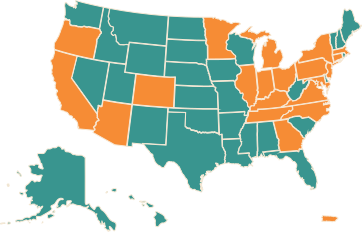
30 U.S. cities
14 Fellows now in faculty positions

“I feel more confident than ever in my work, ideas, and ability to express myself. This program was transformative.”

– Fellow

Our Diversity

Our Fellows are significantly more racially diverse compared to science and engineering doctoral students overall in the U.S.- at least 78% are people of color.

26% identify as LGBTQIA+
18% identify as disabled
53% identify as women
35% are first-generation college graduates
32% attended an HBCU, HSI, MSI, community college, and/or tribal school

U.S. doctoral students data from National Center for Science and Engineering Statistics, Survey of Graduate Studentsand Postdoctorates in Science and Engineering, 2021.

Multiracial/Other” category for AoC-EJ Fellows includes multiracial only; for U.S. doctoral students, the term includes“Native Hawaiian and Other Pacific Islander and more than one race.”

Where Our Fellows Hail From

Fellows were predominantly doctoral students (61%) and postdocs (23%), with our program attracting top early career scientists from public and private schools, government and NGOs across the U.S.

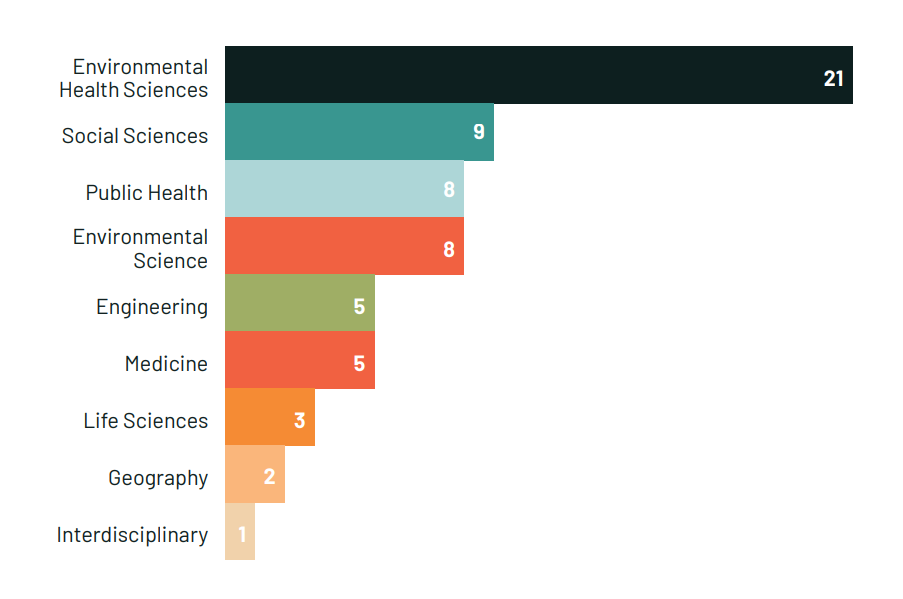
Fellows' Areas of Expertise

Fellows undertake research that covers a breadth of topics in environmental and climate justice.

“Being in a carefully curated space with other scholars of color who are committed to advancing environmental justice and health equity has facilitated conversations and amplified perspectives that I rarely encounter in the spaces that I occupy on a regular basis.”

– Fellow

Our Impact

Environmental Health News publishes our fellows’ ideas in narrative essays and a podcast that dive into the career paths, research, and big ideas from past and present fellows and other leaders in the field of environmental justice.

100+ podcast episodes
80k+ listeners
60 essays
&
1.8M views
1.9k followers
740 followers

Fellow spotlights


How has the Fellowship impacted your career and work?
The program overall expanded my knowledge across the landscape of environmental justice, health and policy and helped me gain a new perspective and a new voice.

In the essay, I was able to express myself in a way that integrated what I was learning and communicate differently from what scientists are typically taught. In science, we are often discouraged from expressing our opinions or emotions, with the idea that data should speak for itself. It was nice to get out of that box and write about why I cared so much about water quality, policy and the environmental injustices that are happening to Indigenous communities. I still get people contacting me about the essay, even years later.

Meeting a community of people from different sectors that all shared the same passion and creating deep professional connections and friendships—this was a wonderful surprise I didn’t expect that has been so valuable to me.
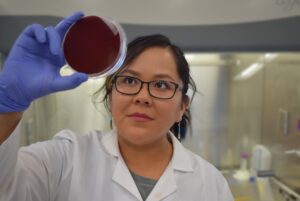
How has the Fellowship impacted your career and work?
When it came to describing myself and my story, I had a specific way of thinking about it. Writing the essay helped me build more skills and flexibility, allowing me to adapt my story to different audiences – skills I continue to rely on today.
Building longitudinal and meaningful relationships with other Fellows has helped me continue to broaden my perspective, as well as learning from each new cohort of Fellows- this experience and exposure matters so much.
I’ve found that others really value the unique perspectives I bring, such as on the White House Environmental Justice Advisory Council. My perspective is interdisciplinary, and I am able to embed clinical knowledge in the larger social and environmental context, with lived human experience at the center.

Why did you apply for the Fellowship?
For your research to have impact in making change you must be able to explain it to the public and policy makers in an understandable way- yet communications is one of the biggest gaps in typical scientific education. I was looking for an opportunity to do a deep dive in how to communicate about my research on endocrine disrupting chemicals. The fellowship really filled in missing pieces of training on communications and policy that I didn’t get in graduate school.

Interested in reading more? View our full impact report here.

Search

Use the Filter checklists to explore different forms of media as well as different subjects – or tags – that our fellows cover in their work.

Filter by Media Type
Filter By Tag
Filter By Tag
More...